Stephan Lo
fb0ec3fd57
Stephan Lo
fb0ec3fd57
Added .markdownlintignore to exclude legacy v1 documentation and blog posts from markdown linting. This allows the team to focus on maintaining quality for actively maintained documentation while avoiding the need to fix 200+ pre-existing lint errors in historical content. Excluded paths: - content/en/docs/v1/** (legacy v1 documentation with historical lint debt) - content/en/blog/** (blog posts with varied formatting styles) Fixed markdown linting errors in current documentation: - content/en/docs/_index.md: Removed excessive blank lines - content/en/docs/decisions/0001-pipeline-tools.md: * Converted emphasis (**Pro**, **Con**) to proper h4 headings * Improves document structure and accessibility * Maintains visual hierarchy while meeting markdown standards Fixed sample v1 files that were blocking CI: - content/en/docs/v1/solution/tools/Crossplane/provider-kind/_index.md: * Replaced hard tabs with spaces (MD010) * Added language tags to code blocks (bash) - content/en/docs/v1/solution/tools/kyverno integration/_index.md: * Added blank line before list items (MD032) * Added language tags to code blocks (bash) Impact: - task test:quick now passes cleanly - CI pipeline markdown validation succeeds - New documentation maintains high quality standards - Legacy content preserved without blocking development This approach balances: 1. Maintaining quality for actively developed docs 2. Not requiring massive refactoring of legacy content 3. Enabling clean CI/CD pipeline 4. Providing clear quality standards for future contributions |
||
|---|---|---|
| .devcontainer | ||
| .github/workflows | ||
| .vscode | ||
| assets | ||
| content/en | ||
| layouts | ||
| resources | ||
| scripts | ||
| static | ||
| .dockerignore | ||
| .env.versions | ||
| .gitignore | ||
| .gitmodules | ||
| .htmltest.yml | ||
| .htmlvalidate.json | ||
| .markdownlint.json | ||
| .markdownlintignore | ||
| config.yaml | ||
| devbox.json | ||
| devbox.lock | ||
| DOCKER.md | ||
| Dockerfile | ||
| edgeconnectdeployment.yaml | ||
| go.mod | ||
| go.sum | ||
| hugo.toml | ||
| k8s-deployment.yaml | ||
| LIKEC4-QUICKSTART.md | ||
| package-lock.json | ||
| package.json | ||
| README-developer.md | ||
| README.md | ||
| RELEASE.md | ||
| Taskfile.yml | ||
| TESTING.md | ||
| VERSIONS.md | ||
IPCEICIS-DeveloperFramework Documentation
This repo contains business and architectural design and documentation of the DeveloperFramework subproject of IPCEI-CIS.
How to read and contribute to this documentation locally
The documentation is done in Hugo-format.
Hugo is a static site renderer - so to get the documentation site presented you need a running Hugo processor. Therefore there is
- either a Hugo
.devcontainer-definition - just run a devcontainer aware IDE or CLI, e.g. Visual Studio code - or a Hugo
Devbox-definition - in this case just run a devbox shell
Local installation of the Hugo documentation system
We describe two possible ways (one with devcontainer, one with devbox) to get the Hugo-documentation system locally running.
For both prepare the following three steps:
- open a terminal on your local box
- clone this repo:
git clone https://forgejo.edf-bootstrap.cx.fg1.ffm.osc.live/DevFW/website-and-documentation - change to the repo working dir:
cd website-and-documentation
Possibility 1: Hugo in a devcontainer
devcontainers are running containers as virtual systems on your local box. The defintion is in the .devcontainer folder.
Thus as preliminary you need a container daemon running, e.g. Docker.
There are several options to create and run the devcontainer - we present here two:
Option 1: Run the container triggered by and connected to an IDE, e.g. VS Code
- open the repo in an Devcontainer-aware tool/IDE (e.g.
code .) - start the
devcontainer(in VSC it'sF1 + Reopen in Devcontainer) - when the container is up & running just open your browser with
http://localhost:1313/
Option 2: Run the container natively
An alternative to get the container image is the devcontainer CLI, then you can run the devcontainer without VS Code. Thus as preliminary you need to do the install steps of the devconatiner cli.
- start the devcontainer by running:
devcontainer up --workspace-folder . - find out the IP address of the devconatiner by using
docker psanddocker inspect <id of container> - when the container is up & running just open your browser with
http://<DOCKER IP>:1313/
Possibility 2: Hugo in a devbox
Devboxes are locally isolated environments, managed by the Nix package manager. So first prepare the devbox.
Then
devbox shell- In the shell:
hugo serve
Editing
Documentation language
The documentation is done in Docsy-Theme.
So for editing content just goto the content-folder and edit content arrording to the Docsy documentation
Commiting
After having finished a unit of work commit and push.
Annex
Installation steps illustrated
When you run the above installation, the outputs could typically look like this:
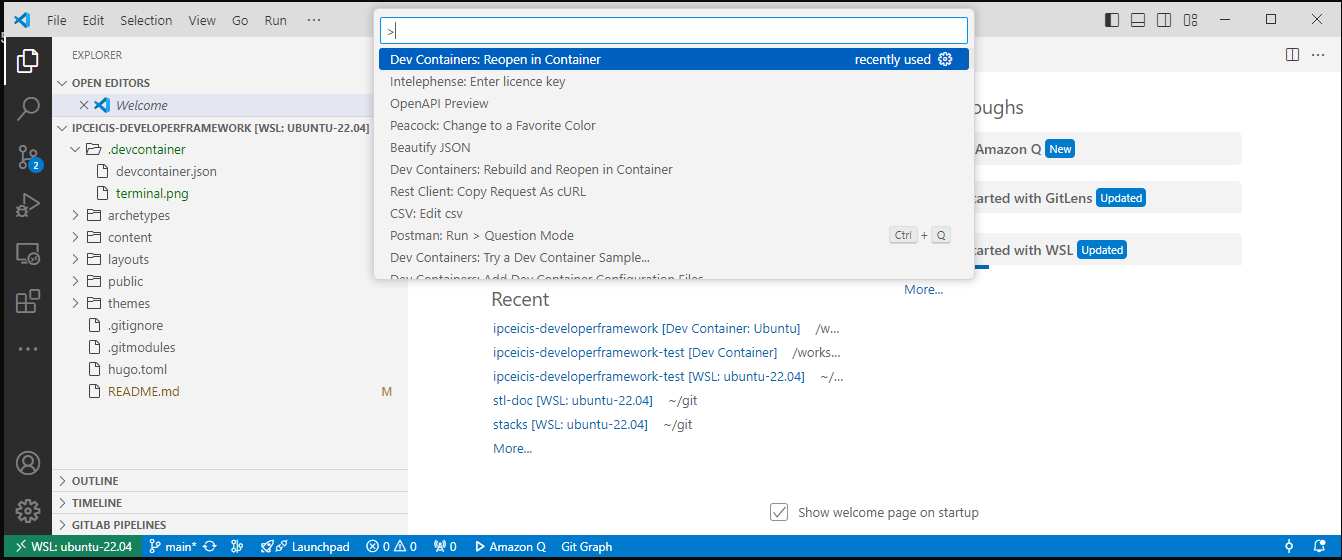
In Visual Studio Code
Reopen in Container
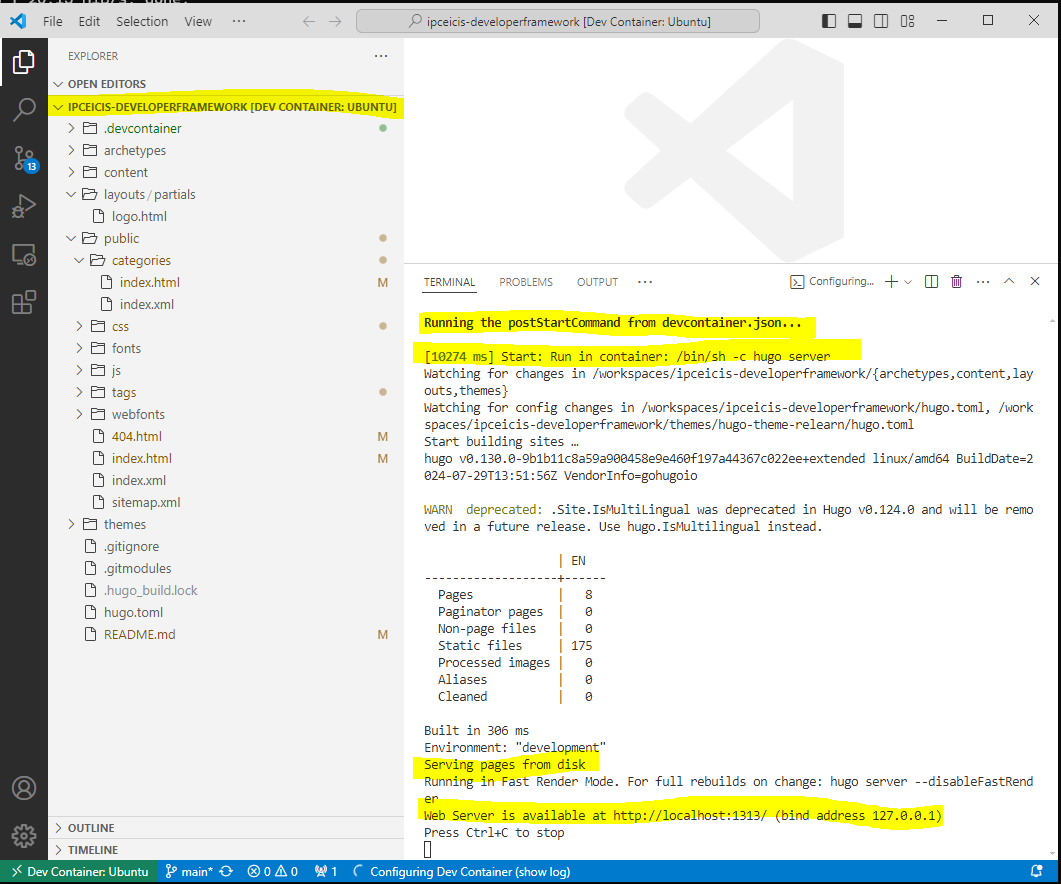
Hugo server is running and (typically) listens to localhost:1313
After some installation time you have:
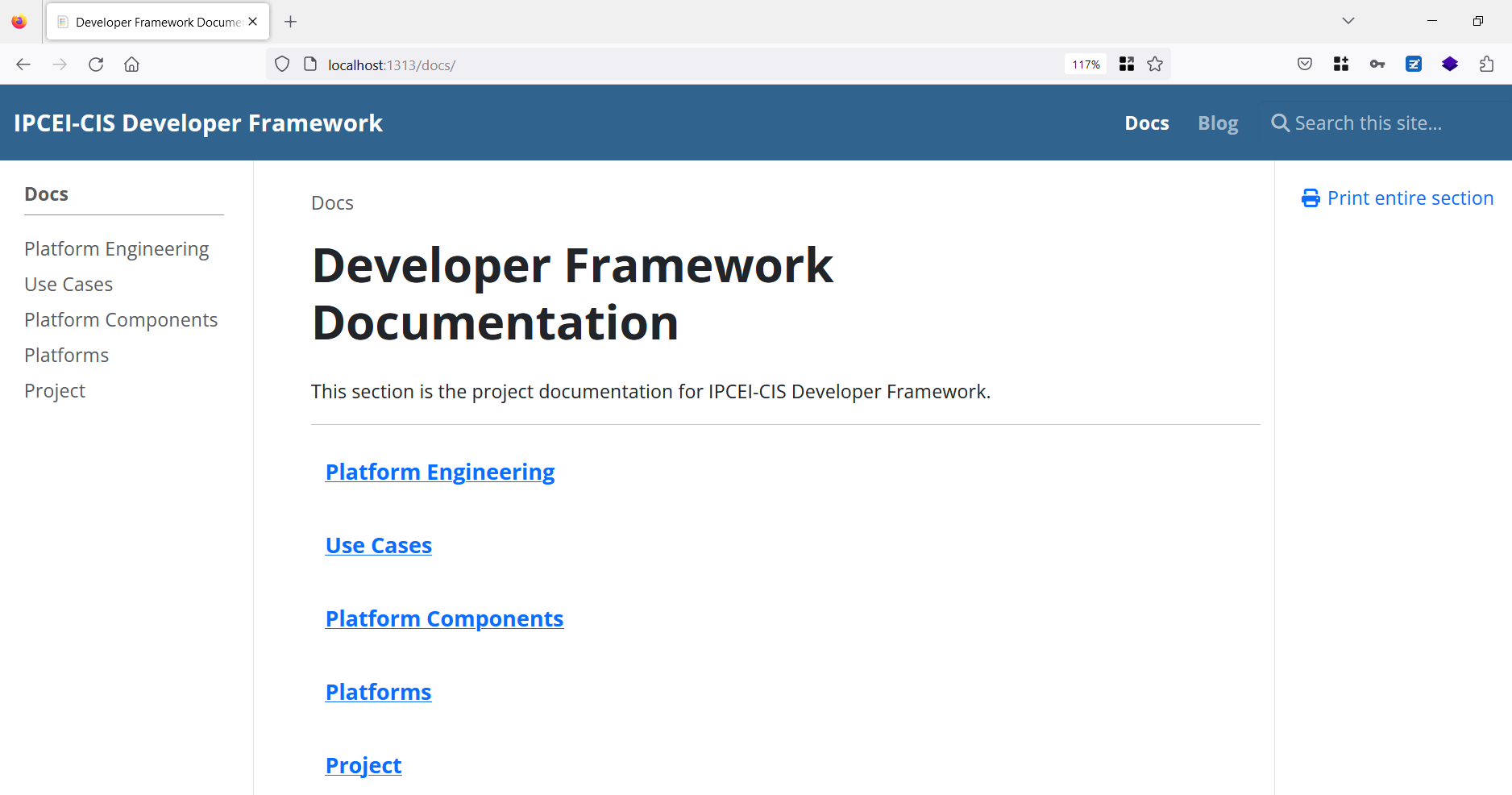
Final result in a web browser